State Teachers' Association Minutes
Source Images
Transcription
STATE TEACHERS' ASSOCIATION. 1023

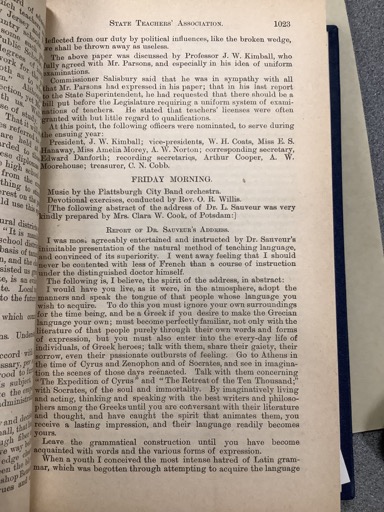
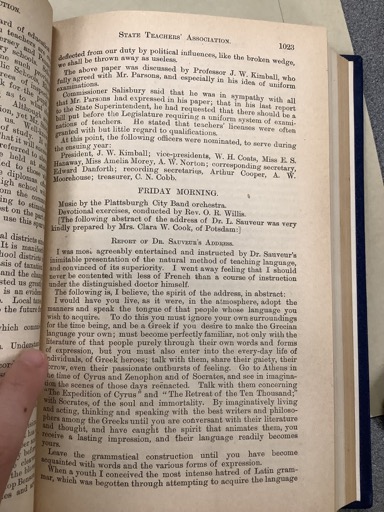
reflected from our duty by political influences, like the broken wedge, we shall be thrown away as useless.

The above paper was discussed by Professor J. W. Kimball, who fully agreed with Mr. Parsons, and especially in his idea of uniform examinations.

Commissioner Salisbury said that he was in sympathy with all that Mr. Parsons had expressed in his paper; that in his last report to the State Superintendent, he had requested that there should be a bill put before the Legislature requiring a uniform system of examinations of teachers. He stated that teachers' licenses were often granted with but little regard to qualifications.

At this point, the following officers were nominated to serve during the ensuing year:
President, J. W. Kimball; vice-presidents, W. H. Coats, Miss E. S. Hanaway, Miss Amelia Morey, A. W. Norton; corresponding secretary, Arthur Cooper; recording secretaries, Edward Danforth, A. W. Moorehouse; treasurer, C. N. Cobb.

FRIDAY MORNING.

Music by the Plattsburgh City Band orchestra.
Devotional exercises, conducted by Rev. O. R. Willis. [The following abstract of the address of Dr. L. Sauveur was very kindly prepared by Mrs. Clara W. Cook, of Potsdam:]

REPORT OF DR. SAUVEUR'S ADDRESS.

I was most agreeably entertained and instructed by Dr. Sauveur's inimitable presentation of the natural method of teaching language, and convinced of its superiority. I went away feeling that I should never be contented with less of French than a course of instruction under the distinguished doctor himself.

The following is, I believe, the spirit of the address, in abstract:

I would have you live, as it were, in the atmosphere, adopt the manners and speak the tongue of that people whose language you wish to acquire. To do this you must ignore your own surroundings for the time being, and be a Greek if you desire to make the Greek language your own. You must become perfectly familiar, not only with the literature of that people purely through their own words and forms of expression, but you must also enter into the everyday life of individuals, of Greek heroes, talk with them, share their gaiety, their sorrow, even their passionate outbursts of feeling. Go to Athens in the time of Cyrus and Zenophon and of Socrates, and see in imagination the scenes of those days reenacted. Talk with them concerning "The Expedition of Cyrus" and "The Retreat of the Ten Thousand," with Socrates, of the soul and immortality. By imaginatively living and acting, thinking and speaking with the best writers and philosophers among the Greeks until you are conversant with their literature and thought, and have caught the spirit that animates them, you receive a lasting impression, and their language readily becomes yours.

Leave the grammatical construction until you have become acquainted with words and the various forms of expression.

When a youth I conceived the most intense hatred of Latin grammar, which was begotten through attempting to acquire the language
[Note: The page number “1023” is visible at the top right of the page. No stamps, seals, or marginal annotations are visible in this image.]
STATE TEACHERS' ASSOCIATION. 1023

deflected from our duty by political influences, like the broken wedge,
we shall be thrown away as useless.

The above paper was discussed by Professor J. W. Kimball, who
fully agreed with Mr. Parsons, and especially in his idea of uniform
examinations.

Commissioner Salisbury said that he was in sympathy with all
that Mr. Parsons had expressed away as useless.

The above paper was discussed by Professor J. W. Kimball, who
fully agreed with Mr. Parsons, and especially in his idea of uniform
examinations.

Commissioner Salisbury said that he was in sympathy with all
that Mr. Parsons had expressed in his paper to the State Superintendent;
that in his last report, he had requested that there should be
a bill put before the Legislature requiring a uniform system of ex-
aminations of teachers. He stated that teachers' licenses were often
granted with but little regard to qualifications.

At this point, the following officers were nominated, to serve
during the ensuing year:
President, J. W. Kimball; vice-presidents, W. H. Coats, Miss E. S.
Hanaway, Miss Amelia Morey, A. W. Norton; corresponding secretary,
Edward Danforth; recording secretaries, Arthur Cooper, A. W.
Moorehouse; treasurer, C. N. Cobb.

FRIDAY MORNING.

Music by the Plattsburgh City Band orchestra.
Devotional exercises, conducted by Rev. O. R. Willis.
[The following abstract of the address of Dr. L. Sauveur was very
kindly prepared by Mrs. Clara W. Cook, of Potsdam:]

REPORT OF DR. SAUVEUR'S ADDRESS.

I was most agreeably entertained and instructed by Dr. Sauveur's
inimitable presentation of the natural method of teaching language,
and convinced of its superiority. I went away feeling that I
should never be contented with less of French than a course of
instruction under the distinguished doctor himself.

The following is, I believe, the spirit of the address, in abstract:

I would have you live, as it were, in the atmosphere, adopt the
manners and speak the tongue of that people whose language you
wish to acquire. To do this you must ignore your own surroundings
for the time being, and be a Greek if you desire to make the
Grecian language your own; must become perfectly familiar, not
only with the literature of that people purely through their own
words and forms of expression, but you must also enter into the
every-day life of individuals, Greek heroes; talk with them, share
their gaiety, their sorrow, even their passionate outbursts of feeling.
Go to Athens in the time of Cyrus and Zenophon and of Socrates,
and see in imagination the scenes of those days reenacted. Talk
with them concerning "The Expedition of Cyrus" and "The Retreat
of the Ten Thousand;" with Socrates, of the soul and immortality.
By imaginatively living and acting, thinking and speaking with the
best writers and philosophers among the Greeks until you are conversant
with their literature and thought, and have caught the spirit
that animates them, you receive a lasting impression, and their
language readily becomes yours.

Leave the grammatical construction until you have become
acquainted with words and the various forms of expression.

When a youth I conceived the most intense hatred of Latin gram-
mar, which was begotten through attempting to acquire the language