Proceedings of the New York State Teachers Association
Source Images
Transcription
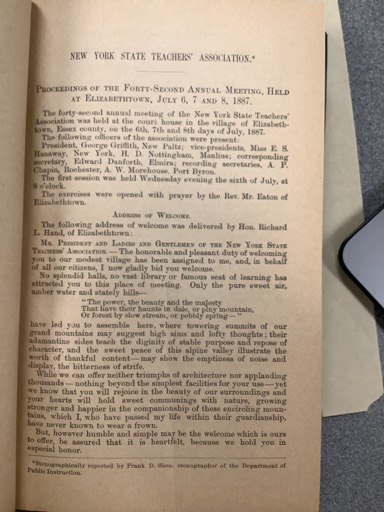
NEW YORK STATE TEACHERS’ ASSOCIATION.*
PROCEEDINGS OF THE FORTY-SECOND ANNUAL MEETING, HELD AT ELIZABETHTOWN, JULY 6, 7 AND 8, 1887.
The forty-second annual meeting of the New York State Teachers’ Association was held at the court house in the village of Elizabethtown, Essex county, on the 6th, 7th and 8th days of July, 1887.
The following officers of the association were present: President, George Griffith, New Paltz; vice-presidents, Miss E. S. Hanaway, New York, H. D. Nottingham, Manlius; corresponding secretary, Edward Danforth, Elmira; recording secretaries, A. P. Chapin, Rochester, A. W. Morehouse, Port Byron.
The first session was held Wednesday evening the sixth of July, at 8 o’clock.
The exercises were opened with prayer by the Rev. Mr. Eaton of Elizabethtown.
ADDRESS OF WELCOME.
The following address of welcome was delivered by Hon. Richard L. Hand, of Elizabethtown:
MR. PRESIDENT AND LADIES AND GENTLEMEN OF THE NEW YORK STATE TEACHERS’ ASSOCIATION.—The honorable and pleasant duty of welcoming you to our modest village has been assigned to me, and, in behalf of all our citizens, I now gladly bid you welcome.
No splendid halls, no vast library or famous seat of learning has attracted you to this place of meeting. Only the pure sweet air, amber water and stately hills—
“The power, the beauty and the majesty That have their haunts in dale, or pine mountain, Or forest by slow stream, or pebbly spring”—
have led you to assemble here, where towering summits of our grand mountains may suggest high aims and lofty thoughts; their adamanite sides teach the dignity of stable purpose and repose of character, and the sweet peace of this alpine valley illustrate the worth of thankful content—may show the emptiness of noise and display, the bitterness of strife.
While we can offer neither triumphs of architecture nor applauding thousands—nothing beyond the simplest facilities for your use—yet we know that you will rejoice in the beauty of our surroundings and your hearts will hold sweet communings with nature, growing stronger and happier in the companionship of these encircling mountains, which I, who have passed my life within their guardianship, have never known to wear a frown.
But, however humble and simple may be the welcome which is ours to offer, be assured that it is heartfelt, because we hold you in especial honor.
*Stenographically reported by Frank D. Shea, stenographer of the Department of Public Instruction.
[stamp: New York State Teachers’ Association]
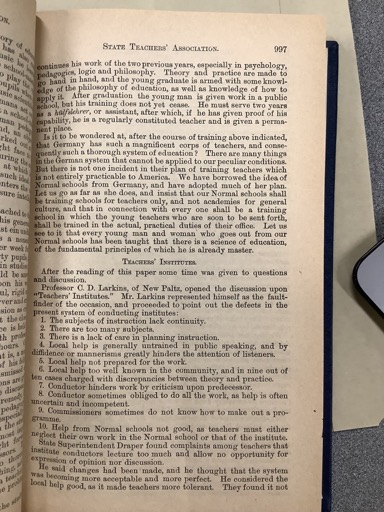
STATE TEACHERS' ASSOCIATION. 997

continues his work of the two previous years, especially in psychology, pedagogy, logic and philosophy. Theory and practice are made to go hand in hand, and the young graduate is armed with some knowledge of the philosophy of education, as well as knowledge of how to apply it. After graduation the young man is given work in a public school but his training does not yet cease. He must serve two years as a halslehrer, or assistant, after which, if he has given proof of his capability, he is a regularly constituted teacher and is given a permanent place.

Is it to be wondered at, after the course of training above indicated, that Germany has such a magnificent corps of teachers, and consequently such a thorough system of education? There are many things in the German system that cannot be applied to our peculiar conditions. But there is not one incident in their plan of training teachers which is not entirely practicable to America. We have borrowed the idea of Normal schools from Germany, and have adopted much of her plan. Let us go as far as she does, and insist that our Normal schools shall be training schools for teachers only, and not academies for general culture, and that in connection with every one shall be a training school in which the young teachers who are soon to be sent forth, shall be trained in the actual, practical duties of their office. Let us see to it that every young man and woman who goes out from our Normal schools has been taught that there is a science of education, of the fundamental principles of which he is already master.

TEACHERS' INSTITUTES.

After the reading of this paper some time was given to questions and discussion.
Professor C. D. Larkins, of New Paltz, opened the discussion upon "Teachers' Institutes." Mr. Larkins represented himself as the faultfinder of the occasion, and proceeded to point out the defects in the present system of conducting institutes:

1. The subjects of instruction lack continuity.
2. There are too many subjects.
3. There is a lack of care in planning instruction.
4. Local help is generally untrained in public speaking, and by diffidence or mannerisms greatly hinders the attention of listeners.
5. Local help not prepared for the work.
6. Local help too well known in the community, and in nine out of ten cases charged with discrepancies between theory and practice.
7. Conductor hinders work by criticism upon predecessor.
8. Conductor sometimes obliged to do all the work, as help is often uncertain and incompetent.
9. Commissioners sometimes do not know how to make out a programme.

10. Help from Normal schools not good, as teachers must either neglect their own work in the Normal school or that of the institute. State Superintendent Draper found complaints among teachers that institute conductors lecture too much and allow no opportunity for expression of opinion nor discussion.

He said changes had been made, and he thought that the system was becoming more acceptable and more perfect. He considered the local help good, as it made teachers more tolerant. They found it not
[Page 998]
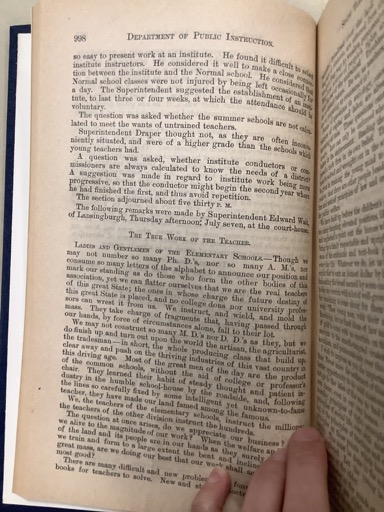
DEPARTMENT OF PUBLIC INSTRUCTION.
so easy to present work at an institute. He found it difficult to select institute instructors. He considered it well to make a close connection between the institute and the Normal school. He considered that Normal school classes were not injured by being left for a day. The Superintendent suggested the establishment of an institute, to last three or four weeks, at which the attendance should be voluntary.
The question was asked whether the summer schools are not calculated to meet the wants of untrained teachers. Superintendent Draper thought not, as they are often inconveniently situated, and were of a higher grade than the schools which young teachers had.
A question was asked, whether institute conductors or commissioners are always calculated to know the needs of a district? A suggestion was made in regard to institute work being more progressive, so that the conductor might begin the second year where he had finished the first, and thus avoid repetition.
The following remarks were made by Superintendent Edward Waite of Lansingburgh, Thursday afternoon, July seven, at the court-house:
THE TRUE WORK OF THE TEACHER.
LADIES AND GENTLEMEN OF THE ELEMENTARY SCHOOLS.—Though we may not number so many Ph. D.’s, not so many A. M.’s, nor consume so many letters of the alphabet to announce our position and mark our standing as do those who form the other bodies of this association, yet we can flatter ourselves that we are the real teachers of this great State; the ones in whose charge the future destiny of this great State is placed, and no college dons nor university professors can wrest it from us. We instruct, and wield, and mold the fragments that, having passed through our hands, by force of circumstances alone, fall to their lot.
We may not construct so many M. D.’s nor D. D.’s as they, but we do finish up and turn out upon the world the artisan, the agriculturist, in short, the whole producing class that build up, clear away and push on the thriving industries of this vast country in this driving age. Most of the great men of the day are the product of the common schools, without the aid of college or professor’s chair. They learned their habit of steady thought and patient industry in the humble school-house by the roadside, and following in the lines so carefully fixed by some intelligent yet unknown-to-fame teacher, they have made our land famed among the famous.
The teachers of the elementary schools, instruct the millions. The question at once arises, do we appreciate our business? When the welfare and the prosperity of the land and its people are in our hands as they surely are, and we train and form to a large extent the bent and inclining mass, are we doing our best that our work shall achieve the most good?
There are many difficult and new problems to solve. New and sturdy books for teachers to solve four.
[illegible]