1922 Department of Public Instruction Report
Source Images
Transcription
1022

DEPARTMENT OF PUBLIC INSTRUCTION.

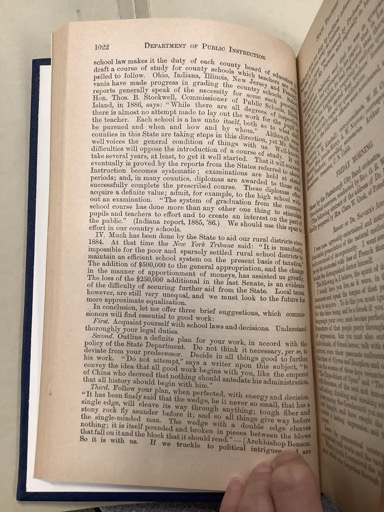
school law makes it the duty of each county board of education to draft a course of study for county schools which teachers are to pelled to follow. Ohio, Indiana, Illinois, New Jersey &c have made progress in grading the country schools. Pen- vania have made progress in grading the country schools. School Hon. Thos. B. Stockwell, Commissioner of Public Schools Rhode Island, in 1886, says: "While there are all degrees of schools in this State, there is almost no attempt made to lay out the work for the pupil to be pursued and when and how and by whom." Each school is a law unto itself, both as to what the pupil should be taught and how it should be taught. The teacher. Each school is a law unto itself, both as to what the pupil should be taught and how it should be taught. The teacher.

Although some counties in this State are taking steps in this direction, yet Mr. Stockwell says that difficulties will oppose the introduction of a course of study. Well-known difficulties will oppose the introduction of a course of study. It will take several years, at least, to get it well started. That it will eventually is proved by the reports from the States referred to. Instruction becomes systematic; examinations are held at stated periods; and in many counties, diplomas are awarded to those who successfully complete the prescribed course. These diplomas often acquire a definite value; admit, for example, to the high school without examination. "The system of graduation from the common school course has done more than any other thing from the common school course has done more than any other thing to stimulate pupils and teachers to effort and to create an interest on the part of the public." (Indiana report, 1885, '86.) We should use this spur to effort in our country schools.

IV. Much has been done by the State to aid our rural districts since 1884. At that time the New York Tribune said: "It is manifestly impossible for the poor and sparsely settled rural school districts to maintain an efficient school system on the present basis of taxation." The addition of $500,000 to the general appropriation, and the change in the manner of apportionment of moneys, has assisted us greatly. The loss of the $250,000 additional in the last Senate, is an evidence of the difficulty of securing further aid from the State. Local taxes, however, are still very unequal, and we must look to the future for more approximate equalization.

In conclusion, let me offer three brief suggestions, which commissioners will find essential to good work:

First. Acquaint yourself with school laws and decisions. Understand thoroughly your legal duties.

Second. Outline a definite plan for your work, in accord with the policy of the State Department. Do not think it necessary, per se, to deviate from your predecessor. Decide in all things good to further his work. "Do not attempt," says a writer upon this subject, "to convey the idea that all good work begins with you, like the emperor of China who decreed that nothing should antedate his administration, that all history should begin with him."

Third. Follow your plan, when perfected, with energy and decision.

"It has been finely said that the wedge, when it is never so small, that has a single edge, will cleave its way through anything; tough fiber fly asunder before it; and so all things give way before the single-minded man. The wedge with a double edge cleaves that fall and the block that should rend. So it is with us. If we truckle to political intrigues &c are
[Note: The text is transcribed exactly as it appears in the image, including all original spelling, capitalization, punctuation, and formatting. The last sentence is cut off in the image, so it is also cut off in the transcription. There are no visible stamps, seals, or marginal annotations in this particular image.]