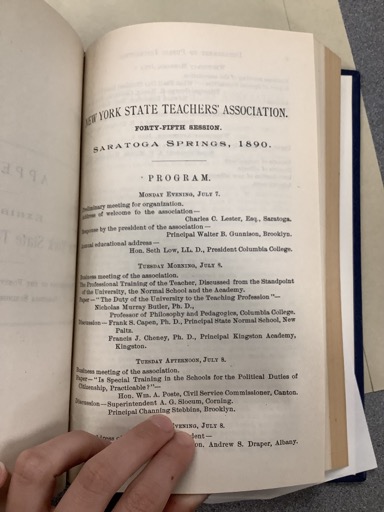
New York State Teachers' Association Program
Source Images
Transcription
NEW YORK STATE TEACHERS’ ASSOCIATION.
FORTY-FIFTH SESSION.
SARATOGA SPRINGS, 1890.
PROGRAM.
MONDAY EVENING, JULY 7.
Preliminary meeting for organization.
Address of welcome to the association—
Charles C. Lester, Esq., Saratoga.
Response by the president of the association—
Principal Walter B. Gunnison, Brooklyn.
Annual educational address—
Hon. Seth Low, LL.D., President Columbia College.
TUESDAY MORNING, JULY 8.
Business meeting of the association.
The Professional Training of the Teacher, Discussed from the Standpoint of the University, the Normal School and the Academy.
Paper—“The Duty of the University to the Teaching Profession”—
Nicholas Murray Butler, Ph.D.,
Professor of Philosophy and Pedagogics, Columbia College.
Discussion—Frank S. Capen, Ph. D., Principal State Normal School, New Paltz.
Francis J. Cheney, Ph. D., Principal Kingston Academy, Kingston.
TUESDAY AFTERNOON, JULY 8.
Business meeting of the association.
Paper—“Is Special Training in the Schools for the Political Duties of Citizenship, Practicable?”—
Hon. Wm. A. Poste, Civil Service Commissioner, Canton.
Discussion—Superintendent A. G. Slocum, Corning.
Principal Channing Stebbins, Brooklyn.
[illegible]
[stamp: New York State Teachers’ Association]
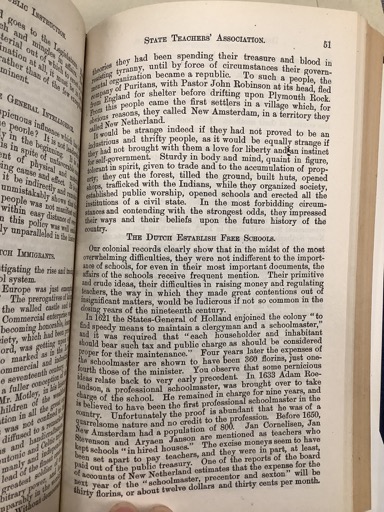
STATE TEACHERS' ASSOCIATION.                                                                 51

theories they had been spending their treasure and blood in
resisting tyranny, until by force of circumstances their
government organization became a republic. To such a people, the
mental organization of Puritans, with Pastor John Robinson at its
head, fled from England for shelter before drifting upon Plymouth
Rock. From this people came the first settlers in a village which
for obvious reasons, they called New Amsterdam, in a territory
they called New Netherland.

It would be strange indeed if they had not proved to be an
industrious and thrifty people, as it would be equally strange if
they had not brought with them a love for liberty and an instinct
for self-government. Sturdy in body and mind, and in figure,
tolerant in spirit, given to trade and to the accumulation of
property; they cut the forest, tilled the ground, built huts,
opened shops, trafficked with the Indians, while they organized
society, established public worship, opened schools and erected
all the institutions of a civil state. In the most forbidding
circumstances and contending with the strongest odds, they
impressed their ways and their beliefs upon the future history of
the country.

THE DUTCH ESTABLISH FREE SCHOOLS.

Our colonial records clearly show that in the midst of the most
overwhelming difficulties, they were not indifferent to the
importance of schools, for even in their most important documents,
the affairs of the schools receive frequent mention. Their
primitive and crude ideas, their difficulties in raising money and
regulating teachers, the way in which they made great contentions
out of insignificant matters, would be ludicrous if not so common
in the closing years of the nineteenth century.

In 1621 the States-General of Holland enjoined the colony
"to find speedy means to maintain a clergyman and a schoolmaster,"
and it was required that "each householder and inhabitant
should bear such tax and public charge as should be considered
proper for their maintenance." Four years later the expenses of
the schoolmaster are shown to have been 360 florins, just one-
fourteenth of those of the minister. You observe that some
pernicious ideas relate back to very early precedent. In 1633 Adam
Roe[?]landson, a professional schoolmaster, was brought over to
take charge of the school. He remained in charge for nine years,
and charge, and is believed to have been the first professional
schoolmaster in the country. Unfortunately the proof is abundant
that he was of a quarrelsome nature and no credit to the profession.
Before 1650, New Amsterdam had a population of 800. Jan
Cornelisen, Jan Stevenson and Aryaen Janson are mentioned as
teachers who kept schools "in hired houses," and they were in
part, at least, set apart to pay teachers, and they were in part,
at least, set apart to pay teachers, and they were in part, at
least, set apart to pay teachers. One of the reports of the board
paid out of the public treasury. One of the reports of the board
of accounts of New Netherland estimates that the expense for the
next year of the "schoolmaster, preceptor and sexton" will be
thirty florins, or about twelve dollars and thirty cents per month.
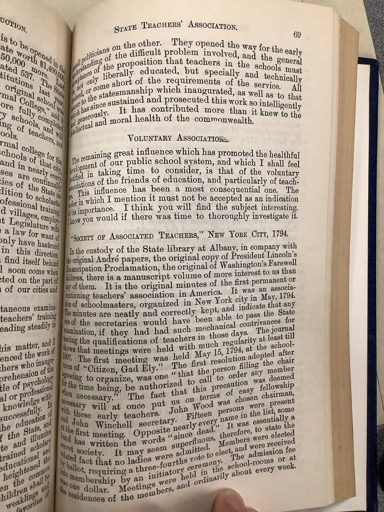
STATE TEACHERS' ASSOCIATION.                                                                 69

small politicians on the other. They opened the way for the early
understanding of the difficult problem involved, and the general
acceptance of the proposition that teachers in the schools must
not only be liberally educated, but specially and technically
trained, or come short of the requirements of the service. All
honor to the statesmanship which inaugurated, as well as to that
which has since sustained and prosecuted this work so intelligently
and generously. It has contributed more than it knew to the
intellectual and moral health of the commonwealth.

VOLUNTARY ASSOCIATIONS.

The remaining great influence which has promoted the healthful
development of our public school system, and which I shall feel
justified in taking time to consider, is that of voluntary
associations of the friends of education, and particularly of
teachers. This influence has been a most consequential one. The
order in which I mention it must not be accepted as an indication
of its importance. I think you will find the subject interesting.
I know you would if there was time to thoroughly investigate it.

"SOCIETY OF ASSOCIATED TEACHERS," NEW YORK CITY, 1794.

In the custody of the State library at Albany, in company with
the original André papers, the original copy of President Lincoln's
Emancipation Proclamation, the original of Washington's Farewell
Address, there is a manuscript volume of more interest to us than
any of them. It is the original minutes of the first permanent or
continuing teachers' association in America. It was an association
of schoolmasters, organized in New York city in May, 1794. The
minutes are neatly and correctly kept, and indicate that any one
of the secretaries would have been able to pass the State
examinations for testing the qualifications of teachers in those
days. The journal shows that meetings were held with much regularity
at least till 1807. The first meeting was held May 15, 1794, at the
schoolroom of "Citizen, Gad Ely." The first resolution adopted after
the meeting was one "that the person filling the chair for the time
being, be authorized to call to order any member when necessary."
The fact that this precaution was deemed necessary will at once put
us on terms of easy fellowship with these early teachers. John
Wood was chosen chairman, and John Winchell secretary. Fifteen
persons were present at the first meeting. Opposite nearly every
name in the list, some person has written the words "since dead."
It was essentially a hand-to-hand society, opposite nearly every
name in the list, some person has written the words "since dead."
It was essentially a hand-to-hand society. It may seem superfluous,
therefore, to state the secret society. It may seem superfluous,
therefore, to state the fact that no ladies were admitted. Members
were received by ballot, requiring a three-fourth vote to elect.
The admission fee or at one dollar. Meetings were held in the
school-rooms or at the residences of the members, and ordinarily
about every week.