The Journal - Minutes and Proceedings of the Board of Trade
Source Images
Transcription
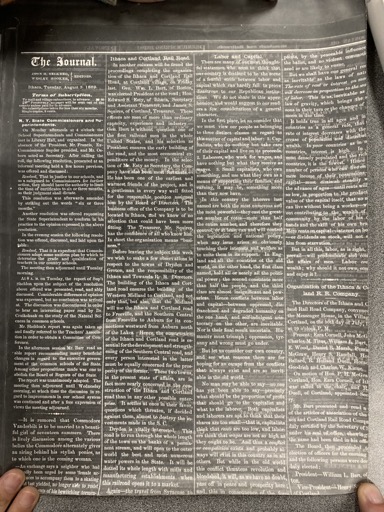
``` The Journal. J. H. SELKIRK, WESLEY HOOKER, EDITORS. Ithaca, Tuesday, August 3, 1869.
Terms of Subscription. N.Y. STATE COMMISSIONERS AND SUPERINTENDENTS. On Monday afternoon at 4 o’clock the School Commissioners and Superintendents met in Library Hall, and organized. In the absence of the President, Mr. Francis, Esq., Superintendent, Mr. O’wns was elected President, and Mr. O’wns acted as Secretary. After calling the roll, the following resolution, presented at an informal meeting held a few hours previous, was offered and discussed: Resolved, That in justice to our schools, and to the Commissioners, it should have the authority to limit the time of certificates to six or three months, as their judgment shall dictate. This resolution was afterwards amended by striking out the words “six or three months.” Another resolution was offered requesting the School Superintendent to conform to his opinion expressed in the above resolution. In the evening session the following resolution was offered, discussed, and laid upon the table: Resolved, That it is expedient that Commissioners appoint some method by which they determine the grade and qualification of teachers in our county schools. The meeting then adjourned until Tuesday morning.
At A.M. on Tuesday, the report of Sgt. Sp. upon the subject of the resolution above offered was presented, read, and ably discussed. Considerable difference of opinion was expressed. The discussion was discontinued in order to hear an interesting paper read by Dr. Cruikshank on the study of the Natural Sciences in common schools.
Mr. Sheldon’s report was again taken up and finally referred to the Teachers’ Association to obtain a Committee of Conference.
In the afternoon session Mr. Barr read an able report recommending many beneficial changes in regard to the executive government of the common schools of the State. Among other propositions made one was to abolish the office of the Commissioner of Education. The report was unanimously adopted, and the meeting then adjourned Wednesday morning, at which time the discussion in regard to improvements in our school system was continued and after a free expression of the meeting adjourned.
It is rumored that Commodore Vanderbilt is to be married to a beautiful girl of seventeen summers. There is lively discussion among the various parties as to which is the coming woman. An exchange says a neighbor who had only urged some female relatives to accompany them to a skating party last yielded, no longer able to resist the bewitching charms of his.
Ithaca and Cortland Rail Road. In another column will be found the proceedings completing the organization of the Ithaca and Cortland Road, at Cortland village, on Friday last. Gen. Wm. L. Burt, of Boston, was elected President of the Board; Hon. Edward S. Esty, of Ithaca, Secretary and Assistant Treasurer; and James S. Squires, of Cortland, Treasurer. These officers are of more than ordinary capacity, experience and industry. Gen. Burt is without question one of the first railroad men in the whole United States, and his selection as President ensures the early building of the road, and the most economical expenditure of the money. In the selection of Mr. Esty as Secretary, the Company has also been most fortunate. He has been one of the earliest and warmest friends of the project, and is a gentleman in every way well fitted to the responsible position assigned him by the Board of Directors. The business office of the Company is to be located in Ithaca, and we know of no selection that could have been more fitting. The Treasurer, Mr. Squires, has the confidence of all who know him. In short the organization means “business.”
Before leaving the subject we wish to make a few observations in respect to Dryden and Groton, and the responsibility of the Ithaca and Towanda R. R. Directors. The building of the Ithaca and Cortland road ensures the building of the Western Midland to Cortland, and not only that, but also, that the Midland will take the Ithaca and Cortland road to Freesville and the Southern Central from Freesville to Auburn for its connections westward from Auburn north of the Lakes. Hence the construction of the Ithaca and Cortland road is essential for the development and strengthening of the Southern Central road, and every person interested in the latter must be equally concerned for the prosperity of the former. These two towns, in fact more nearly concerned in the construction of the Ithaca and Cortland road than in any other possible enterprise. It settles at once in their favor questions which threaten to destroy the investments made in the S. C. Dryden is highly interested. This road is to run through the whole length of the town on the banks of a permanent stream, and will open to the world the best, and most numerous water powers in the State. It will be dotted with mills and manufacturing establishments when this road opens to a market.
Again—the travel from Syracuse to Buffalo will be greatly facilitated by the completion of this road. The travel from Buffalo to Syracuse will be equally facilitated by the completion of the Western Midland road.
Labor and Capital. There are many of our most thoughtful statesmen who seem to be destined to be the scene of a fearful strife between labor and capital which can hardly fail to prove disastrous to our Republican institutions. We do not share in this apprehension, and would suggest to our readers a few considerations of a general character.
In the first place let us consider that we view our people as belonging to three distinct classes in regard to capital and labor: 1. Capitalists, who do nothing but take care of their capital and live on its proceeds; 2. Laborers, who work for wages, and have nothing but what they receive as wages; 3. Small capitalists, who own something, and use what they own as means of supporting their families, and they may be something more than they now have.
The laborers last named are the most numerous and the most powerful—they cast the greatest number of votes—more than half the entire number—and therefore they control, or at least can at least control the legislation and national policy, when any issue arises to unite their interests and welfare as to their support.
In England the laborers last named are the most numerous and the most powerful—they cast the greatest number of votes—more than half the entire number—and therefore they control, or at least can at least control the legislation and national policy, when any issue arises to unite their interests and welfare as to their support.
In this country the laborers last named are the most numerous and the most powerful—they cast the greatest number of votes—more than half the entire number—and therefore they control, or at least can at least control the legislation and national policy, when any issue arises to unite their interests and welfare as to their support.
In England the laborers last named are the most numerous and the most powerful—they cast the greatest number of votes—more than half the entire number—and therefore they control, or at least can at least control the legislation and national policy, when any issue arises to unite their interests and welfare as to their support.
In this country the laborers last named are the most numerous and the most